
When the London bell rings, the US30 (Dow Jones) often wakes up—liquidity rotates, spreads tighten, and momentum pops. That window can be gold… or chaos. London Pulse Trader US30 EA V1.7 (MT4) aims to turn that morning noise into structure: pre-session range mapping, momentum confirmation, and tight, volatility-aware risk so you’re not chasing candles or guessing your exits. No gimmicks, no martingale, no endless grids—just session-focused logic for a notoriously punchy index.
What Is London Pulse Trader US30 EA V1.7?
London Pulse Trader is a MetaTrader 4 Expert Advisor engineered specifically for US30 during London and London→NY overlap. It combines a pre-session range detector, impulse/momentum filter, and ATR-scaled risk to catch clean continuation moves and avoid the chop.
- Platform: MT4
- Symbol: US30 (a.k.a. Dow Jones 30 CFD; check your broker’s symbol name)
- Style: Session breakout + pullback continuation (not a grid, not martingale)
- Timeframes: M1–M5 entries, with M15/H1 for bias filter
- Who it’s for: Intraday traders and prop-style accounts that must control drawdown
Key Features (Why Traders Pick It)
- Session Engine (London-First): Trades only within your configured London window; optional overlap window for the NY open.
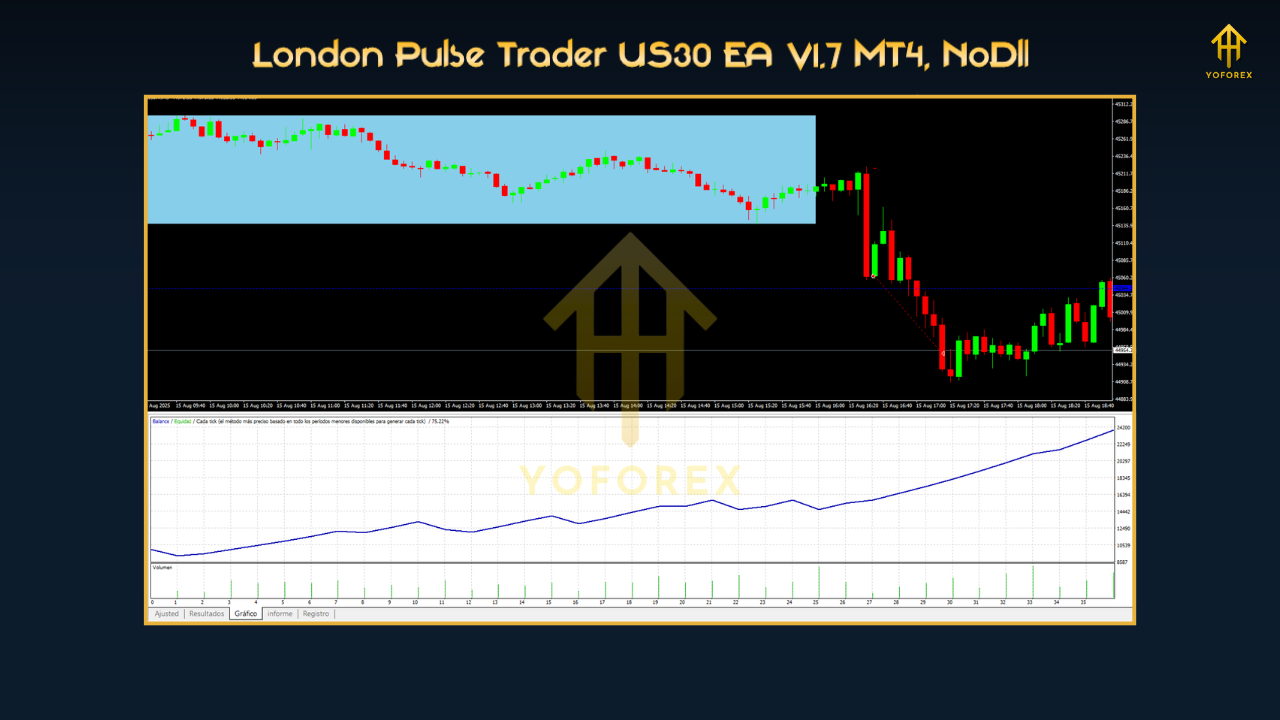
- Pre-Session Range Mapping: Automatically records the Asian→pre-London box, setting clear high/low reference levels.
- Impulse + Pullback Logic: Waits for an impulsive break, then enters on a measured pullback or micro-retest—no raw breakout chasing.
- Volatility-Adaptive Risk: ATR(14)-scaled stops and targets so you don’t run the same SL in sleepy and manic tapes.
- Spread/Slippage Guards: Blocks entries if max spread or max slippage is exceeded (you set the limits).
- News Pause (Manual/External): Temporarily disables new entries around high-impact news windows.
- One-Shot, One-Kill (Optional Pyramid = Off): Single-entry default; optional one add-on when trend quality is extreme (capped).
- Partial Take-Profit & BE: Realize a portion at 1.0R (configurable), shift stop to break-even, and let the runner trail.
- Equity Protection: Daily loss stop, daily trade cap, and max concurrent trades per symbol.
- Lightweight & VPS-Friendly: Efficient code so you can run it on a few charts without your terminal melting.
How the Strategy Works (Plain English)
- Define the Battlefield
During the pre-London hours, the EA draws a reference range. This “box” becomes your liquidity map. - Wait for a Real Move
The EA looks for a decisive break of the box with momentum filters (tick velocity/RSI-style kick, configurable). No convincing break = no trade. - Enter on Orderly Pullback/Retest
After the break, price pulls back. The EA enters on a micro-retest or structure reclaim—aiming to ride continuation, not the initial spike. - Control Risk with ATR
Stops anchor to recent structure ± ATR buffer. Targets are based on R-multiples and/or measured move logic. - Manage the Runner
Once TP1 hits, the EA moves to BE and trails the remainder with either swing or EMA-based logic. Calm and methodical.
Recommended Settings (Starter Presets)
Trade Window (London): 07:30–11:00 London time (adjust for BST/UTC).
Optional NY Window: 13:30–15:30 London time for overlap bursts.
Risk & Filters
- Risk per Trade: 0.25%–0.6% (prop-friendly), up to 1% if personal and experienced.
- ATR Period: 14 (Wilder).
- SL Distance: 1.2×–1.8× ATR, or below/above the micro-structure that defines the retest.
- TP1: 1.0R (take 40–60% off), move stop to BE.
- Final TP / Trail: Either target 1.8R–2.5R or use swing/EMA trail.
Quality Gates
- Max Spread: Set based on your broker’s US30 contract; block if wider.
- Max Slippage: 0.5–1.5 points on fast brokers; adjust to reality.
- News Pause: 15–30 minutes pre/post high-impact releases (CPI, NFP, FOMC, rate decisions).
Trade Hygiene
- Daily Loss Stop: 2%–3% (EA sleeps after hit).
- Daily Trade Cap: 1–3 trades per session to avoid over-trading.
- Max Concurrent Trades: 1 per symbol (2 only if you fully understand exposure).
Broker & Infrastructure Tips (Don’t Skip)
- Contract Spec: US30 point value, min lot step, stop-level distance—know them cold.
- Execution: Look for RAW/ECN with tight spreads on indices.
- Server Time vs. London Time: Map your broker server time to London so the session filter is exact.
- VPS: A low-latency VPS helps with fills around the open.
- Swap/Commissions: Index CFDs carry swap/fees—factor them into your expectancy.
Practical Playbooks You Can Try
1) Box Break + Retest (Textbook)
- Context: Clean pre-London box.
- Trigger: Strong break + momentum confirmation.
- Entry: On the first orderly retest of the broken boundary.
- Stop: Under/over the retest wick ± ATR buffer.
- Take-Profit: Partial at 1R, trail for 2R+.
2) Failed Break Flip (Reclaim)
- Context: False push back into the box… then a swift reclaim with momentum.
- Trigger: Re-break of the original direction with more convincing impulse.
- Why it works: Traps early chasers; London loves to shake then go.
3) Overlap Burst (London→NY)
- Context: Trend is established; NY open adds fuel.
- Trigger: Pullback during 13:30–15:30 London time, then micro-range break with the dominant trend.
- Management: Faster partials; keep the trail tight—volatility can sling both ways.
Risk Management That Actually Protects You
- Respect the Daily Loss Stop—no “one more” trade coz emotions say so.
- Correlation: If you also trade US100/US500, realize it’s synthetic correlation—size down or focus on one.
- Size to the Stop, Not the Feeling: If ATR expands, reduce lot to keep risk % fixed.
- Journal: Track session, spread at entry, ATR, slippage, setup type, and result. Your data will show where your edge really lives.
Backtesting & Forward-Testing (Reality-Checked)
- Data: Use 1-minute + tick data if possible; US30 is spiky—model it.
- Spread/Slippage: Add realistic buffers; “perfect fills” are fantasy.
- Regime Mix: Test trending days, choppy days, heavy-news days; see where the EA shines and where to stand down.
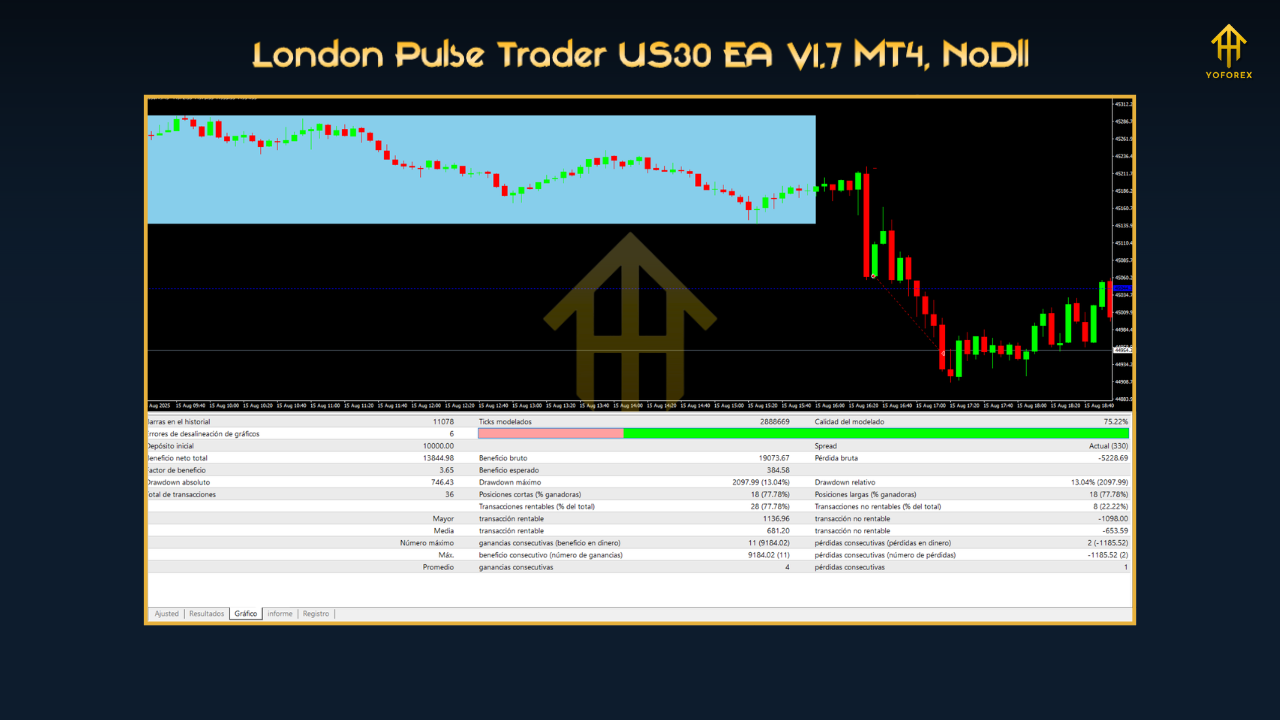
- KPIs to Watch: Hit rate to TP1, average R, max drawdown, average slippage, % trades blocked by spread guard.
Installation (MT4) — Quick Steps
- Download
London-Pulse-Trader-US30-EA-V1.7.ex4. - MT4 → File → Open Data Folder → MQL4 → Experts → paste file.
- Restart MT4 (or right-click Experts → Refresh).
- Drag the EA to your US30 chart (use M1–M5).
- Check Allow live trading; set AutoTrading ON.
- Configure session hours, risk, ATR, quality gates, and news pause.
- Start on demo/VPS; confirm the session mapping and contract behavior.
- Go live only when your forward-test matches expectations.
Troubleshooting
No Trades? Check session times vs. broker server time; spread/ slippage gates may be blocking entries.
Too Many Trades? Raise momentum threshold, narrow session window, or require a deeper pullback.
Stops Too Tight? Increase ATR multiplier or use structure-anchored stops.
Whipsaw Day? That happens—cap trades and let the daily loss stop be the adult in the room.
FAQ
Does it use martingale or grid?
No. Single-entry by default; an optional one-add pyramid exists but is capped and off by default.
Minimum deposit?
Because US30 tick value can be chunky, many traders start with $300–$500 at 0.01 lots and tiny risk (0.25%–0.5%). Your broker specs will decide.
Prop-firm friendly?
Yes, if you configure daily loss stop, trade caps, and conservative risk. Always match your firm’s rulebook.
Can it trade other indices?
V1.7 is tuned for US30. Some users clone the template for US100/US500, but treat that as a separate test with its own settings and stats.
Conclusion
London Pulse Trader US30 EA V1.7 MT4 is built for that exact moment when London injects life into the tape. It doesn’t promise magic—just repeatable logic: map the range, demand momentum, buy the retest, and manage risk like a pro. Start small, forward-test, keep a tight daily stop, and let the stats guide your tweaks. When you’re ready, scale the things that actually work… coz discipline beats drama, every time.


Comments
Leave a Comment