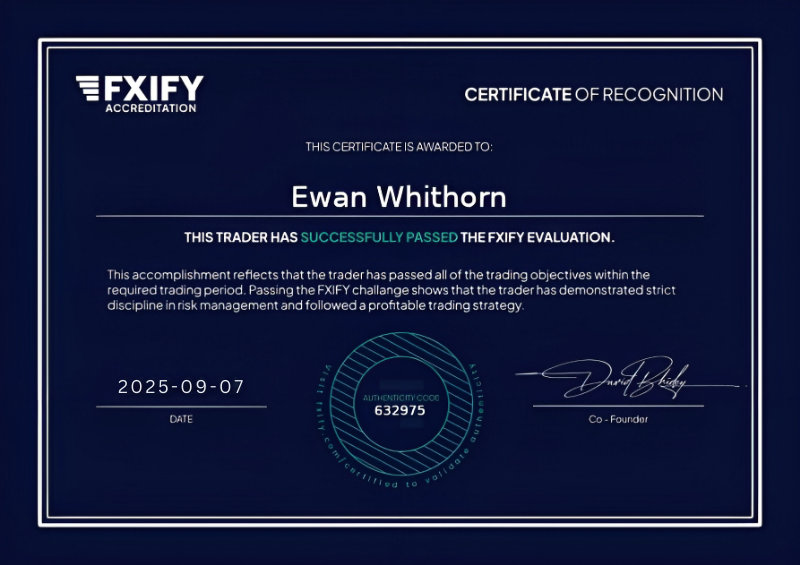
On August 25, 2025, FxCracked received a FIXIFY Accreditation prop firm account from Ewan Whithorn. Over the following days, our team executed a disciplined, process-driven plan to pass the two-stage evaluation and complete the subsequent Evaluation account in line with FIXIFY’s rules and risk parameters. On September 7, 2025, Ewan received the official certificate for his account—closing the loop on a fast, focused, and transparent prop journey. This post documents the approach we took, the timelines we followed, and the lessons we think are most helpful for traders preparing for their own FIXIFY Accreditation process.
What FIXIFY Accreditation Means (and Why It Matters)
Prop firm accreditations like FIXIFY are designed to test a trader’s performance and discipline under clearly defined risk controls. While profit is the goal, consistency and risk management are the true yardsticks. The structure typically emphasizes controlled daily risk, maximum drawdown limits, and adherence to trading rules such as holding during news, weekend exposure, or EA usage depending on the firm’s policy. Passing an accreditation signals that your process—entries, exits, position sizing, and psychological control—can hold up under rules that mirror institutional standards. For our community, this milestone underscores FxCracked’s commitment to methodical execution and measurable accountability.
The Handover: August 25, 2025
On August 25, 2025, we received the FIXIFY account from Ewan Whithorn. The first action wasn’t to place trades; it was to set constraints and systems:
- Sync the platform settings, session alerts, and risk controls in line with FIXIFY’s rules.
- Confirm the broker feed, symbols list, and margin profile to avoid slippage from mismatched instruments or contract sizes.
- Establish a pre-trade checklist focused on rule compliance first, opportunity second.
- Finalize a tracking template for day-by-day metrics: strategy tags, session, R multiple, rule adherence notes, and end-of-day summaries.
That foundation allowed us to move into Stage 1 without ambiguity about what to trade, when to trade, and how to size.
Stage 1: Precision Over Activity
A common mistake in challenges is overtrading early to “get ahead.” We did the opposite. Our Stage 1 plan emphasized precision over activity:
- Fewer, higher-quality setups: Only well-defined patterns with confluence (trend structure, momentum confirmation, and clear invalidation levels).
- Tight execution windows: Focus on liquid sessions with stable spreads and reliable fills.
- Hard risk caps: All positions sized to remain comfortably within daily and overall drawdown rules.
- Structured journaling: Each trade logged with rationale, screenshots, and a short “what would improve this?” note for post-session review.
The result: a smooth equity curve with low variance and no rule breaches—exactly what Stage 1 is designed to surface.
Stage 2: Consistency Is a System
Stage 2 often feels similar to Stage 1, but it carries heightened psychological pressure: you’ve proved you can do it; now you must keep doing it. To maintain consistency, we leaned even more on systems:
- Pre-session routine: Market mapping, key levels, calendar scan, and “no-trade” scenarios documented before any order is placed.
- Execution standardization: Same risk model, same trigger logic, same trade management playbook to avoid ad-hoc decisions.
- Daily debrief: A short post-market review to identify drift (e.g., chasing late entries, widening stops, skipping partials).
- Rule-first mindset: If a setup conflicted with a rule, it was disqualified—no exceptions.
By treating consistency as an operational habit rather than an outcome, Stage 2 unfolded with less stress and fewer decision branches.
Completing the Evaluation Account and Receiving the Certificate
After clearing both stages, we moved through the Evaluation account with the exact same doctrine: safeguard rule compliance, respect risk, and favor clean, repeatable setups. The playbook did not change simply because the label changed from “stage” to “evaluation.” That discipline paid off: on September 7, 2025, Ewan received the FIXIFY Accreditation certificate for his account—validating the entire process end-to-end from the initial handover on August 25.
What Worked for Us (So You Can Replicate It)
1) Rule-Locked Risk Management
Before strategy comes risk limits. We codified max exposure, stop-loss placement, and intraday loss thresholds so that even on a tough day, we stayed eligible and emotionally steady.
2) Trade Fewer Ideas, Manage Them Better
We waited for A-grade setups with strong confluence and clean invalidations. That makes execution faster, exits clearer, and variance lower.
3) Keep Your Playbook Static
No mid-challenge “strategy shopping.” If market conditions are off, reduce size or skip the session. Don’t swap systems to force a win.
4) Ritualize the Daily Cycle
Plan → Execute → Review. The act of writing a brief plan and a short debrief each day prevents drift and keeps you accountable to your own rules.
5) Respect the Calendar
High-impact events can break spreads and invalidate otherwise good structures. If your accreditation rules restrict trading around news, log it and move on.
6) Journal Like an Analyst
Screenshots, notes, and tags (setup type, session, outcome) turn a two-week challenge into a data set you can actually learn from—and reuse on the next account.
What This Milestone Means for the FxCracked Community
For our traders and readers, this successful accreditation is more than a badge. It’s a proof point for a philosophy we talk about constantly:
- A rules-first edge is durable. Algorithms change, volatility cycles shift, but disciplined risk and execution habits travel with you from account to account.
- Consistency is built, not found. It emerges from routines, documentation, and a commitment to saying “no” more often than “yes.”
- Community matters. Having a team and a structure around you—whether that’s a journal template, a peer review, or a checklist—cuts through noise and keeps you objective.
We’re proud to have guided this journey from the August 25 handover to the September 7 certification, and we’re doubling down on the frameworks that got us here.
Practical Takeaways for Your Next Prop Challenge
- Start with constraints. Define what you can’t do before dreaming up what you’ll try to do.
- Pre-commit to risk and session rules. Make them visible on your screen; then don’t negotiate with them mid-trade.
- Trade your best setup—or don’t trade. Passing is about not losing the account as much as it is about winning.
- Automate reminders. Session alerts, calendar popups, and checklists reduce mental load and prevent preventable errors.
- Make your journal your edge. Review it like an earnings call: what worked, what didn’t, and what’s the single improvement for tomorrow?
A Final Word of Thanks
A huge thank-you to Ewan Whithorn for trusting FxCracked with the FIXIFY Accreditation prop firm account. Delivering this outcome—from the August 25, 2025 handover through the September 7, 2025 certificate—was a team effort built on transparent communication, disciplined execution, and shared standards. If you’re preparing for your own accreditation, we hope this case study helps you structure the journey with the same clarity and confidence.
Interested in a structured, rules-first path for your prop journey? Reach out to FxCracked, and let’s design a plan that matches your rules, your risk tolerance, and your timeline—then hold it to the same high bar we set here.




Comments
Leave a Comment